Magical AI Animation: Bringing a Polar Bear on Flying Broomstick to Life from Still Image
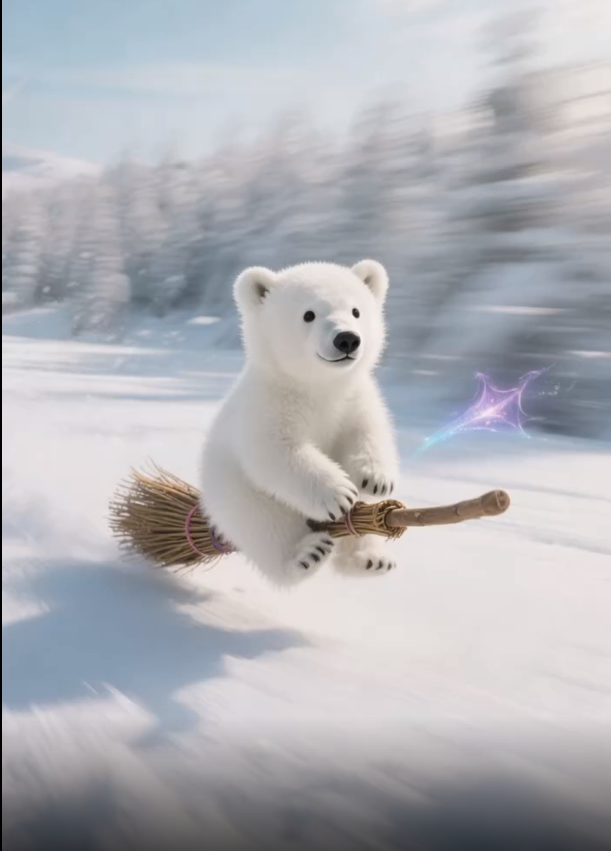
In the realm of digital creativity, the boundaries between imagination and reality are constantly being blurred. Recently, I embarked on an exciting journey by utilizing an advanced image-to-video function to bring a still image of a little polar bear to life, making it appear as if it were flying swiftly on a broomstick. This enchanting transformation was not only a testament to the power of technology but also a glimpse into the future of how AI is reshaping our world.
The Process of Image-to-Video Generation
The creation of this magical scene involved several sophisticated algorithms, each playing a crucial role in transforming a static image into a dynamic video.
Image Processing Algorithms
Edge Detection: The first step in this process was to identify the edges and contours of the polar bear and the broomstick. This was achieved using edge detection algorithms, which allowed for a seamless transition from a still image to a moving video.
Object Detection: Advanced object detection algorithms, such as YOLO (You Only Look Once) or SSD (Single Shot MultiBox Detector), were employed to accurately pinpoint the locations of the polar bear and the broomstick within the image. This ensured that they were tracked consistently throughout the video.
Motion Prediction and Synthesis
Physics-Based Simulations: To simulate the realistic motion of the polar bear flying on the broomstick, physics-based simulations were used. These simulations took into account factors such as gravity, air resistance, and the aerodynamic properties of the broomstick, creating a believable and fluid motion.
Deep Learning Models: Neural networks, particularly those utilizing Generative Adversarial Networks (GANs) or Variational Autoencoders (VAEs), were instrumental in predicting and generating the motion of the polar bear. These models learned from vast datasets of motion videos, enabling them to create realistic and smooth movements that were indistinguishable from real life.
Video Stabilization and Enhancement
Stabilization Algorithms: To ensure the video was smooth and free from jitters, stabilization algorithms were applied. These algorithms analyzed the motion of the polar bear and adjusted the video frames accordingly, resulting in a seamless and polished final product.
Enhancement Techniques: Post-processing techniques, such as color correction, noise reduction, and sharpness enhancement, were used to further improve the visual quality of the video. These enhancements made the scene even more captivating and immersive.
The Power of Current Technology
The ability to transform a simple image into a dynamic video underscores the incredible power of today's technology. This technological advancement is not just a novelty but a game-changer that is revolutionizing industries and improving our daily lives.
Entertainment and Creativity: The entertainment industry has been profoundly impacted by AI-generated content. From animated movies to interactive games, AI is enabling creators to bring their wildest imaginations to life in ways that were once thought impossible.
Convenience and Efficiency: In our daily lives, AI is making tasks more convenient and efficient. From personalized news feeds to smart home devices, AI is integrating seamlessly into our lives, making them more streamlined and tailored to our preferences.
The Impact of AI on Our Future Lives
As AI continues to evolve, its impact on our lives will only grow more profound. Here are some ways in which AI is poised to shape our future:
Enhanced Creativity and Innovation: AI will continue to push the boundaries of what is possible, enabling new forms of art, storytelling, and entertainment. From AI-generated music to interactive virtual reality experiences, the possibilities are endless.
Personalization and Customization: AI will play a crucial role in personalizing experiences for individuals. From tailored product recommendations to personalized health and wellness plans, AI will make our lives more convenient and tailored to our unique needs.
Ethical Considerations and Transparency: As AI becomes more integrated into our daily lives, ethical considerations will become increasingly important. Ensuring that AI is used responsibly and transparently will be essential for maintaining trust and avoiding potential misuse. This includes clearly labeling AI-generated content to avoid misleading users and respecting their privacy.
In conclusion, the image-to-video function that allowed me to make the little polar bear fly on a broomstick is just one example of the incredible power of AI. This technology is not only transforming the way we create and interact with digital content but also reshaping our lives in ways that were once the stuff of science fiction. As AI continues to evolve, we can expect even more profound changes and opportunities in the years to come. The future of AI is bright, and the possibilities are truly endless.